Branding is not only about logos, colours, or taglines. Branding shapes how people see a company. It builds trust. It builds recall. It builds long-term demand. But many business owners still ask one important question: how do we measure the ROI of branding?
Measuring branding ROI is not simple like tracking paid ads. Branding works slowly. It builds memory in the mind of customers. Still, it can be measured in a clear and structured way.
In this article, we will explain brand value measurement, brand ROI metrics, and how companies can measure brand value in a practical manner.
Why Measuring the ROI of Branding Matters
Branding needs investment. It includes:
- Brand strategy
- Visual identity
- Website design
- Content marketing
- Campaign creative
- PR and media exposure
- Social media storytelling
- CRM brand communication
If a company spends money on these services, it must understand the branding ROI. According to Bain & Company, strong brands deliver higher pricing power and long-term sales growth. Research shows that businesses with strong brand equity can charge more than competitors. This means brand marketing ROI is not only about short-term sales. It is also about premium pricing and customer loyalty.
What is Brand Value Measurement?
Brand value measurement means calculating the financial impact of brand perception. It connects branding activity with business outcomes.
Brand value can be measured in three levels:
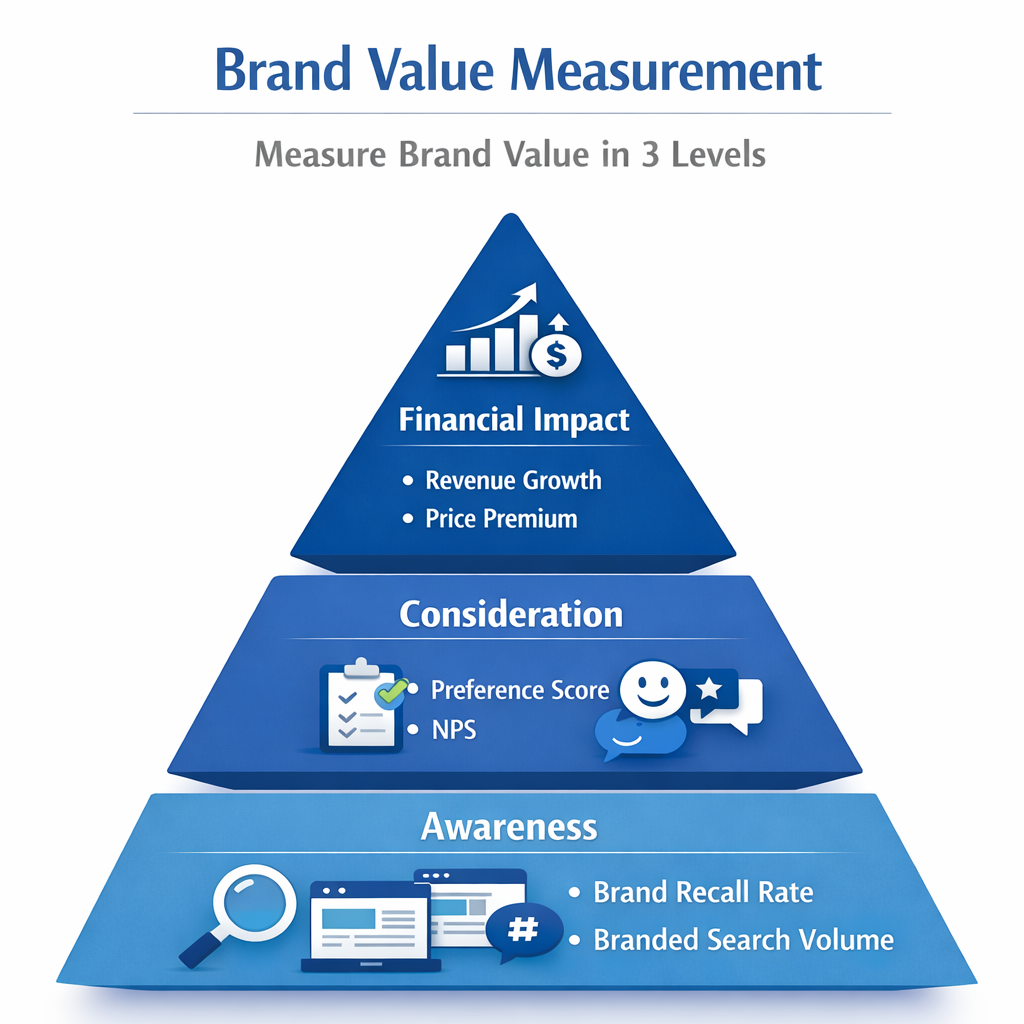
| Level | What It Measures | Example |
| Awareness | Do people know the brand? | Brand recall rate |
| Consideration | Do people prefer the brand? | Preference survey |
| Financial Impact | Does the brand increase revenue? | Revenue growth |
A report by WIPO shows that intangible brand assets contribute up to 33% of total company value in large global firms. This proves that branding ROI is real and measurable.
Step 1: Track Brand Awareness Metrics
Brand awareness is the first stage of brand ROI.
Key brand ROI metrics include:
- Direct website traffic growth
- Branded search volume (Google Search Console)
- Social media mentions
- Share of voice in industry
- Media coverage
For example, if branded search volume increases by 40% after a rebranding campaign, this shows improvement in brand value measurement.
According to Hootsuite, brands with high awareness receive more organic clicks even without paid ads. This reduces future advertising costs. That is part of the ROI of branding.
Step 2: Measure Brand Perception
Brand perception tells us how people feel about a brand.
Tools used:
- Customer surveys
- Net Promoter Score (NPS)
- Online reviews
- Social sentiment analysis
A study by Hubspot found that companies with high NPS scores grow at more than double the rate of competitors. That growth is direct evidence of branding ROI.
For example, if customer trust improves after a brand positioning campaign, and repeat purchases increase, the brand marketing ROI becomes visible.
Step 3: Calculate Customer Lifetime Value (CLV)
Branding improves loyalty. Loyal customers buy more and stay longer.
Customer Lifetime Value formula:
CLV = Average Purchase Value × Purchase Frequency × Customer Lifespan
If branding increases emotional connection, customers return more often. Even a 5% increase in retention can increase profits by 25% to 95%, according to research from Harvard Business Review.
This shows how brand ROI works over time.
Step 4: Track Pricing Power
Strong branding allows higher pricing.
For example:
| Company | Strong Brand? | Price Premium |
| Apple | Yes | High |
| Generic Tech Brand | No | Low |
Brand equity allows companies to charge more without losing customers. That extra margin is branding ROI.
If after repositioning, a real estate developer increases price per square foot by 8% without losing demand, this is measurable brand value measurement.
Step 5: Monitor Conversion Improvement
Branding also improves performance marketing results.
Strong brands:
- Reduce cost per lead
- Improve click-through rate
- Increase conversion rate
- Lower customer acquisition cost
According to Forbes, consistent branding across all channels increases revenue by up to 23%.
If after a full brand refresh, conversion rate improves from 2% to 3%, that 1% growth can significantly increase revenue. That difference is part of brand ROI.
Step 6: Measure Long-Term Revenue Growth
Short-term ads bring quick sales. Branding builds long-term growth.
A famous study by Think With Google shows that 60% of marketing budget should go to brand building for sustainable growth.
Their research found that businesses investing in long-term brand building see stronger market share growth compared to short-term focused brands.
This shows that branding ROI may not appear in one month. It appears over years.
Some Examples of Real Estate Branding ROI
Imagine a luxury property launch.
Before branding:
- Low brand recall
- High cost per lead
- Limited investor trust
After structured branding:
- Strong visual identity
- Strategic storytelling
- High-end campaign design
- CRM-based brand communication
Results:
- 30% increase in qualified leads
- 15% increase in property booking rate
- Higher investor confidence
That improvement represents measurable brand marketing ROI.
Key Brand ROI Metrics to Track
Below are core brand ROI metrics every company should monitor:
| Metric | Why It Matters |
| Brand Recall | Measures awareness |
| Branded Search Volume | Indicates demand |
| NPS Score | Shows loyalty |
| Conversion Rate | Connects brand to sales |
| Customer Lifetime Value | Long-term profitability |
| Revenue Growth | Final business impact |
| Price Premium | Reflects brand strength |
Tracking these metrics helps companies measure brand value clearly.
How to Connect Branding to Revenue
To calculate ROI of branding:
Branding ROI Formula:
ROI = (Revenue Growth – Branding Cost) ÷ Branding Cost
Example:
If branding investment = $200,000
Revenue growth linked to branding = $500,000
ROI = (500,000 – 200,000) ÷ 200,000
ROI = 150%
This shows strong branding ROI.
However, revenue growth must be linked to branding impact using data models like attribution analysis and brand tracking studies.
Why Many Businesses Fail to Measure Brand ROI
Common mistakes:
- Only tracking short-term sales
- Ignoring brand awareness metrics
- Not using surveys
- No consistent reporting system
- Separating creative from performance
Brand value measurement needs structured dashboards. It needs CRM integration. It needs consistent data tracking across campaigns, websites, social media, and offline touchpoints.
Final Thoughts
Branding is not an expense. It is an investment. The ROI of branding may not be visible immediately, but over time it creates pricing power, loyalty, and sustainable growth.
When businesses track brand ROI metrics such as awareness, perception, retention, pricing power, and revenue growth, they can clearly measure brand value and understand their brand marketing ROI.
Pixl Global helps businesses connect branding with measurable financial impact through structured reporting, performance integration, and long-term brand planning.
Frequently Asked Questions
Companies use controlled testing, brand lift studies, and marketing mix modeling. These methods separate short-term ad effects from long-term brand impact to calculate accurate branding ROI and brand marketing ROI contribution.
Advanced tools include econometric modeling, brand tracking surveys, customer lifetime value analysis, and attribution software. These systems connect awareness, perception, and revenue data to measure brand value precisely.
Strong brands reduce price sensitivity. When customers accept higher pricing without volume decline, it proves brand strength. This pricing power directly improves profit margins and strengthens the measurable ROI of branding.
Brand equity appears indirectly through goodwill, intangible asset valuation, and market capitalization growth. Analysts use brand value measurement models like the Interbrand methodology to estimate financial brand contribution.
Branding ROI often appears over 6 to 24 months. Early signs include increased branded search, improved conversion rates, and higher retention. Long-term impact is reflected in sustained revenue and margin growth.